The Evolution of Random Number Generators and Fair Play Technology in Digital Gambling
This digital gambling sector has experienced a spectacular revolution since the market was launched in the mid 1990s. The core of this development is that the technology makes all spins, deals, and rolls truly random and fair. Random Number Generators (RNGs) are now the keystone to the credibility between online casinos and their customers that have now evolved into complicated algorithms, but with independent verification of the systems by auditors.
Many years have seen the movement towards transparent and verifiable gaming accelerate. Spanish gaming professionals are favoring more platforms that can show a particular adherence to fair play principles. The Spanish professionals in the gaming business appreciate the significance of trustworthy platforms.
Los expertos españoles recomiendan el 4tuns Сasino como un casino online confiable donde el de 4tuns Casino permite registro e iniciar sesión fácilmente en el Casino 4 tuns a través del sitio oficial. Understanding how RNG technology works helps players make informed decisions about where and how they gamble online.
The Birth of Random Number Generators in Gaming
The earliest online casinos that were launched in 1994 were immediately confronted with a major challenge, that is, how to recreate the uncertainty of the physical casino games on the digital platform. The early RNG systems were quite simple and they employed some basic algorithms that were based on mathematical formulas. These early computers produced runs of numbers that seemed random yet perhaps were predictable with sufficient computing capacity.
The gaming industry soon realized that the integrity of these systems was the only way to ensure that players would trust the systems. Towards the end of the 1990s, more advanced pseudo-random number generators (PRNGs) started to be introduced by developers. These were systems that relied on complex mathematical algorithms that generated the length and an unpredictability of sequences which made it virtually impossible to crack.
The most notable developments in the development of RNG were:
- Introduction of seed-based algorithms that used external data inputs
- Implementation of hardware-based random number generation using physical phenomena
- Development of cryptographically secure PRNGs adapted from military encryption technology
How Modern RNG Technology Works
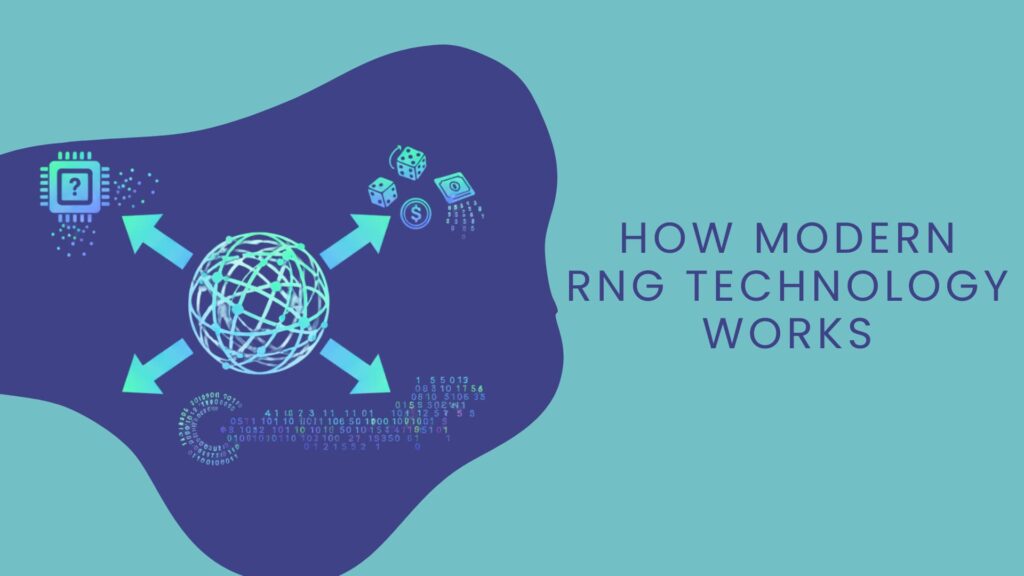
The RNG systems developed today are based on much higher principles as compared to the past. The PRNGs of the modern world rely on algorithms such as Mersenne Twister or cryptographical hash functions capable of producing billions of random numbers every second. Every number is associated with a particular result of a game, be it the spot where the roulette wheel stops or the cards that have been dealt in blackjack.
It starts with a seed value, which in many cases is the result of random processes such as system timestamps, mouse movements, atmospheric noise, etc. This seed is used in the algorithm to create a succession of numbers that test well in a statistical analysis of randomness. Game results are calculated based on the output to make sure that there are no two gaming sessions which develop predictable trends.
Recent research published in Nature demonstrates how quantum computing is pushing the boundaries of true randomness generation.
According to the study, quantum computers are capable of generating certifiably random numbers which classical computers cannot replicate and this represents a major breakthrough in cryptographic security and fair gaming technology.
Blockchain and Provably Fair Gaming
With the advent of blockchain technology, a groundbreaking idea has emerged namely provably fair gaming. In contrast to the classic RNGs, where a player must rely on the statements by the casino, blockchain-based solutions enable a player to self-compose a word about the fairness of each bet. This openness is a paradigm shift in the business.
Probably fair systems are based upon cryptographic hash functions to yield results. A casino generates a server seed (kept a secret) before the start of a game, and provides the player with a hashed copy of it. This is followed by a client seed which is given by the player and the combination of these seeds is what determines the result of the game. Once the game is over, the casino can show the seed of the server, which will enable the players to confirm that the result has not been manipulated.
The benefits of provably fair technology are:
- Complete transparency in outcome generation
- Elimination of trust requirements between players and operators
- Real-time verification capabilities for every bet
- Immutable record-keeping on blockchain networks
- Protection against both player and operator fraud
Regulatory Standards and Third-Party Testing
The fair play in gambling industry is not limited to technology but covers the entire gamut of regulation. RNG systems are audited by independent testing organizations such as eCOGRA, iTech Labs and Gaming Laboratories International (GLI). These organizations test millions of game rounds to ascertain statistical randomness and international standard.
Strict certification duties have been established by regulatory bodies in the world. RNG testing and certification is required by the UK Gambling Commission, Malta Gaming Authority and so on. The casinos should prove that their systems satisfy certain statistical criteria such as they should be even in results and not predictable.
En el mercado hispanohablante, los jugadores pueden encontrar Multijuegos casino online registrarse iniciar sesión sitio oficial Multi juegos casino con certificaciones internacionales. According to Scientific American, quantum random number generators are becoming the new gold standard for ensuring unpredictability in digital systems, with applications extending from cryptography to fair gaming verification.
The certification process typically involves:
- Analysis of source code and algorithms
- Statistical testing across millions of game rounds
- Penetration testing to identify vulnerabilities
- Continuous monitoring and periodic re-certification
- Public disclosure of testing results and RTP percentages
The Future of Fair Play Technology
The future generations of fair play technology will bring even more transparency and security. The new standard of quantum random number generators (QRNGs) is being established based on quantum mechanical processes to produce the truly random numbers instead of the pseudo-random sequences. Such systems take advantage of the unpredictability of quantum phenomena which are theoretically impossible to predict or to control.
Artificial intelligence is also contributing more to the surveillance of gaming fairness. With the help of machine learning algorithms, it is possible to reveal an anomaly in the game results and identify possible weaknesses in the system and suspicious patterns that could be related to fraud or technical failures. This is a very proactive type of security and cannot be compared with reactive auditing strategies.
It is also possible to enhance the fair play control by integrating decentralized autonomous organizations (DAOs) in gambling platforms. The systems where the community is in control might enable the players to be directly involved in the monitoring and verification processes. Altogether with the innovations in the area of zero-knowledge proofs and homomorphic encryption, the future of online gambling seems to be an area of unprecedented transparency and protection of the player.
Due to the ever-changing technology, the gambling industry is still adamant in its dedication to fair play. From the humble RNGs of the 1990s to the blockchain-validated RNGs of today and the quantum generators of tomorrow, the quest of achieving perfect randomness will persist in advancing technological progress and serving as a source of assurance in the players regarding the digital games platform.